Why Outboards Lose Power Specifically Under Load
Outboard troubleshooting has gotten complicated with all the guesswork flying around. As someone who limped a 150-horse Yamaha back to the dock in the Keys on a dying throttle response, I learned everything there is to know about under-load power loss. Today, I will share it all with you.
But what is under-load power loss? In essence, it’s when your engine runs fine at idle but bogs, stumbles, or cuts out the moment you push the throttle. But it’s much more than that. It’s a fundamentally different problem than a rough idle or a no-start condition — and diagnosing it the same way will waste your whole afternoon. Idle masks weakness. Eight hundred RPM doesn’t ask much from your fuel delivery or ignition. Four thousand RPM does. A filter that passes just enough fuel at low speed starves everything above it. A borderline plug fires clean at low load, then misfires when heat and cylinder pressure climb. That’s what makes under-load diagnosis its own thing entirely.
Start Here — Fuel Delivery Is the First Suspect
Clogged fuel filter. Kinked fuel line. Hardened primer bulb. Those three account for maybe 70% of under-load cases. Probably should have opened with this section, honestly.
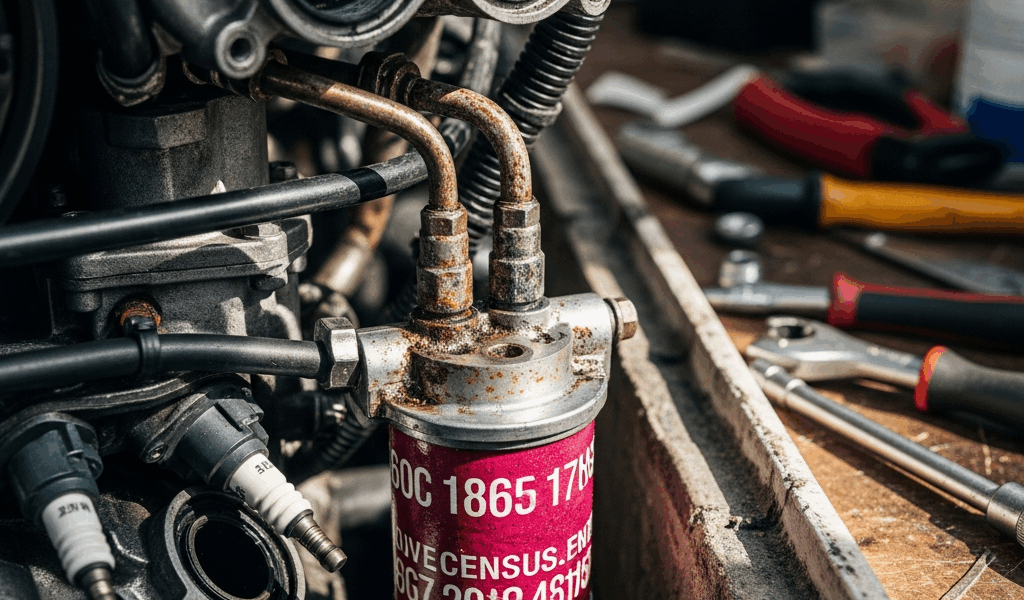
The fuel filter is the easiest win. Most outboards run an inline filter between the tank and the carburetor — a clear plastic bowl, usually holding a white or yellow replaceable cartridge. Pull the boat out of the water and find yours. Look through the bowl. Dark brown or black debris coating the element? Found it. A replacement cartridge runs eight to fifteen dollars and swaps out in thirty seconds. Grab a small catch cup first — fuel will spill, no avoiding it.
Next, squeeze the rubber fuel line. It should feel firm, not like a dried-out garden hose from 1987. Rock-hard rubber has degraded internally and is already restricting flow. Also trace the line from tank to engine and look for kinks. I once found a line routed behind a storage locker on a 2019 Mako 21 — compressed flat every time someone sat in the port seat. Invisible unless you knew exactly where to look. Don’t make my mistake.
The primer bulb is the inline hand pump sitting between the tank line and engine. Squeeze it ten times with the engine off. You want strong resistance, then a little hiss from the vent. Squishy and pressure-free means the internal valve is cracked. Replace the whole assembly — they run about $12 to $25 at any marine supply counter.
Here’s a field test worth knowing: engine running, someone holding steady throttle around 2,500 RPM, watch the primer bulb. If it’s pulling inward — creating visible suction — fuel delivery is restricted somewhere upstream. A healthy system leaves the bulb neutral or slightly outward.
Once the fuel line checks out, pull the carburetor bowl — four bolts, usually — and shine a flashlight inside. Tan or brown crusty deposits on the jets are varnish buildup from ethanol fuel. Spray cleaner won’t fix that. You need the carb soaking overnight in a small container of actual marine carburetor cleaner fluid, not an aerosol. One night in the solution, and months of varnish comes off.
Check the Fuel Tank and Vent
This one kills me because it’s so simple. The tank vent — a small plastic tube running off the cap to atmosphere — clogs with lint, debris, whatever finds its way into the tank strap area. When it seals up, the tank pulls vacuum as fuel gets consumed. Air can’t replace what’s leaving. The engine runs fine initially, then loses power once the vacuum overwhelms the fuel pump’s pull.
Test takes twenty seconds. Engine running at cruising throttle, loosen the fuel cap slightly. Hear a hiss of air rushing inward? Vent is clogged. Power improves almost immediately when you do this — that’s your confirmation. Tighten the cap, then remove it fully, clean the vent tube with a finger or small brush, and reinstall. Simple fix, embarrassingly easy to miss.
Ethanol fuel deserves a mention here. U.S. gasoline runs up to 10% ethanol, which absorbs water. Under high-load or warm conditions, that absorbed water can separate inside the carb and cause a lean stumble. Fuel sitting in your tank for more than a month is a real suspect. Drain it, switch to fresh Top Tier fuel or ethanol-free marine gasoline — the price difference is negligible, and the difference in symptom behavior is not.
Spark and Ignition Problems That Show Up Under Load
A fouled plug hides at idle. Low cylinder pressure, low temperature — it gets away with it. Push the throttle up and spark demand climbs fast. A plug gapped wider than 0.040 inches, or one caked in black carbon deposits, starts misfiring under that demand. You feel it as a bog or stumble at mid-throttle, sometimes followed by a brief recovery that makes you think the problem fixed itself. It didn’t.
Pull your plugs and look at the center electrode. Light tan or white means healthy combustion. Black crusty deposits mean the fuel mixture is running rich. A gap beyond 0.050 inches is too wide — full stop. Replace both plugs with OEM or marine-rated equivalents, gapped to 0.040 inches. NGK BUHW-2 or Champion L78V are common fits depending on the engine — check your manual for the exact spec.
Clean plugs, correct gap, power loss still there under load? Now suspect the ignition coil. That component steps low voltage up to the several thousand volts needed to fire the plug reliably. I’m apparently sensitive to coil failures — my previous 90-horse Evinrude had two coil failures in four years, and a multimeter showed nothing wrong at room temperature either time. The coil tests fine cold, then fails when the engine warms up and load increases. Symptoms include misfire that worsens the harder you push, or an intermittent stutter at speed that smooths out when you back off. Coils run $80 to $180 depending on engine brand and vintage. Replacement means pulling the cowling and disconnecting a two-pin connector — straightforward, maybe forty-five minutes the first time.
When to Suspect the Water Pump or Prop
Fuel checks out. Ignition checks out. Two less-obvious suspects remain — and both get overlooked constantly.
The water pump impeller is a rubber disc with blades that pull cooling water through the engine. Over time, the blades wear flat and move less water. The engine runs progressively hotter under load. Modern outboards respond to rising coolant temperature by retarding ignition timing — pulling power back to protect the engine from detonation. You might catch a temperature alarm on your gauge, or just notice the power loss only develops after five or ten minutes of hard running. That timing is the tell. Inspecting the impeller means dropping the lower unit, which requires removing the outboard from the bracket or using a proper engine stand. Handy boater with a socket set? Budget ninety minutes. Service shop? Budget a couple of hours of labor.
A wrong or damaged prop creates excessive load that mirrors power loss symptoms exactly — but isn’t a power loss at all. It’s the engine working too hard against the wrong resistance. A bent blade or cavitation damage should show up during a pre-trip visual. Pitch is less visible. Too high a pitch number and the boat won’t come on plane without strain. Too low and the engine over-revs past its rated RPM band. Your owner’s manual lists the correct pitch range for your engine and boat weight combination — cross-reference it before replacing anything else.
So, without further ado, here’s the diagnostic order start to finish: fuel filter, fuel line condition, primer bulb, tank vent, carburetor soak, spark plugs, ignition coil, water pump impeller, then prop pitch. Work through them in sequence. The fault is in that list somewhere — it always is.


Stay in the loop
Get the latest nautical soundings updates delivered to your inbox.