Gelcoat Repair on a Boat — Step by Step for First-Timers
Boat gelcoat repair has gotten complicated with all the conflicting tutorials, forum arguments, and suspiciously vague YouTube videos flying around. I know because I spent three hours down that rabbit hole the first time I stood in my driveway staring at a gouge on my 2003 Bayliner. Dock cleat caught the hull during a rough landing — left a chip about the size of a quarter, deep enough to expose the white fiberglass underneath the cream gel. I figured I’d find something straightforward, knock it out over a weekend, done. What I actually found were guides written for people who already knew what MEKP was and had apparently repaired gelcoat approximately one thousand times before. This guide is not that. This is for the person standing in the boat aisle at West Marine holding two different products, trying to figure out if they need paste or liquid and whether the $18 kit is a lie.
This article includes affiliate links. We may earn a commission at no extra cost to you.
Spoiler: the $18 kit is kind of a lie. More on that in a minute.
What You Need Before You Start
The shopping list matters more than most tutorials admit. Getting to the hardware store mid-repair because you forgot PVA spray is genuinely terrible — gelcoat has a working window, and wasting it on a supply run kills the whole batch. Buy everything first.
Gelcoat — Paste vs Liquid
But what is gelcoat paste, exactly? In essence, it’s a thickened polyester resin used to form and repair a boat’s outer shell. But it’s much more than that — the formulation determines whether your repair actually stays put or sags off the hull inside 90 seconds. Which brings me to the paste-versus-liquid question.
For hull repairs on vertical or curved surfaces — which describes basically every surface on a trailer boat — paste is the right call. Liquid gelcoat runs. It’s made for large flat horizontal layup work in a shop environment, not driveway spot repairs. I made the mistake of buying liquid on my first attempt because the hardware store was out of paste and I didn’t want to wait. It sagged off the repair almost immediately. Total waste. Don’t make my mistake.
Good brands for small repairs: Evercoat Polyester Gelcoat Paste (around $22 for a small can), TotalBoat Gelcoat — clearly labeled for both formulations — or Interlux if your boat is Interlux-finished. Buy more than you think you’ll need. A quarter-sized chip uses less than you’d imagine, but color matching tests eat material fast.
MEKP Catalyst — The Ratio That Matters
MEKP — methyl ethyl ketone peroxide — is the hardener that activates the gelcoat. Standard mix ratio is 1% to 2% by weight. At around 70°F, 1.5% gives you roughly a 10-to-15-minute working window before things start gelling. Go above 2% and it kicks faster than you can work. Go below 1% and it may not fully cure — or worse, it cures but stays slightly tacky forever because of air inhibition issues we’ll get into later.
Use a graduated mixing cup and a kitchen scale. I used eyeballing the first time. 1.5% of 20 grams of gelcoat paste is 0.3 grams of MEKP — tiny. A few extra drops either direction changes the entire cure behavior. Most gelcoat kits include a small MEKP vial; if yours doesn’t, buy it separately. About $6 at any marine supply store.
Color Matching — The Part Everyone Underestimates
Color matching is honestly the part of this job that decides whether your repair is invisible or obviously patched. Old gelcoat oxidizes. Even a formula-perfect match from the manufacturer won’t look right next to a hull that’s spent years fading in UV light — you’re matching the original color, not the current one.
The real approach: universal pigment tints. Star Brite makes a decent set. Start with white gelcoat paste and mix in small amounts of yellow, brown, gray — whatever gets you close. Test on white cardboard, let it cure, then hold it against the hull in natural daylight. Not indoor light — natural daylight only. Colors shift dramatically between the two. Plan on three or four test batches before you get close. On a cream hull, my color-matching alone took 45 minutes. Budget for that.
Sandpaper and Other Supplies
- Wet/dry sandpaper: 220, 320, 400, 600 grit — buy multiples of each
- PVA mold release spray OR Saran Wrap — for curing (critical, explained below)
- Acetone — a full quart, not a tiny can
- Clean cotton rags, not paper towels
- A Dremel rotary tool with a small grinding bit
- Mixing sticks and small plastic cups
- Marine polish — 3M Perfect-It or Meguiar’s M67
- Painter’s tape
- Nitrile gloves — MEKP is genuinely nasty on skin
That $18 kit from the discount shelf typically includes a tiny tube of pre-mixed gelcoat with no real instructions about air inhibition. Not completely useless — just incomplete for an actual repair. That’s why I called it a lie.
Surface Prep — The Step Most People Rush
Probably should have opened with this section, honestly. Surface prep is where first-timers fail — not the mixing, not the application. The prep. Rush it and the gelcoat won’t bond. Full stop.
Opening the Damage with a Dremel
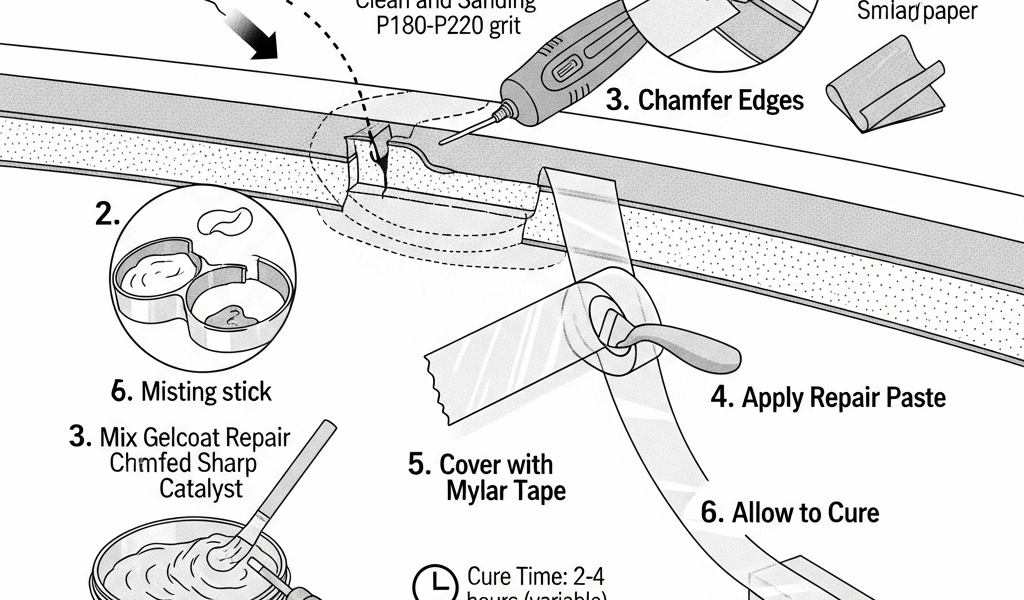
Counter-intuitive truth: you need to make the damage bigger before you can fix it. Gelcoat paste needs mechanical tooth to grip. A hairline crack with smooth walls won’t hold a repair — the new gelcoat will pop right back out within a season or two. Use a Dremel with a small carbide burr to open any cracks into a slight V-shape. For chips, undercut the edges slightly so the new gelcoat has something to lock under.
Work slowly. The goal is a rough, slightly flared cavity — not a gaping hole. Wipe all dust away with a dry rag after grinding.
Wax Removal — The Silent Repair Killer
Wax prevents gelcoat from bonding. Even a thin residue layer — left from your last hull detail — will cause the repair to fail. Strip wax from an area roughly twice the diameter of the damage. Quarter-sized chip means softball-sized wax removal zone, at minimum.
Acetone on a clean cotton rag. Wipe in one direction — scrubbing in circles just redistributes the wax. Fresh section of rag for each pass. Wipe the area twice, letting it flash dry between passes. Acetone evaporates fast at room temperature, so this takes just a few minutes. Don’t substitute lacquer thinner or mineral spirits — both leave residue. Acetone only.
Final Clean Before Application
After wax removal, one more acetone wipe right before you mix anything. Let it flash off completely — about two minutes in normal air. Surface should be bone dry. Any moisture or solvent residue left behind interferes with the cure. This last wipe is the step people skip because they’re impatient to start mixing. Don’t skip it.
Tape off the surrounding area with painter’s tape now, leaving about a 2mm border around the repair. You’ll sand that border later, but the tape keeps wet gelcoat off the polished hull while you work.
Mixing, Applying, and Curing
Temperature matters more than most people realize. Below 65°F, MEKP doesn’t catalyze reliably — you can end up with a gummy, never-fully-cured mess. Above 85°F, working time shrinks fast, sometimes down to five minutes. Ideal range is 65°F to 80°F. Summer heat? Work in the morning. Cold garage? Run a space heater for an hour beforehand, then shut it off before you start mixing.
Mixing the Gelcoat
Measure your gelcoat paste by weight into a plastic cup. For a small repair, 15 to 20 grams is usually plenty. Add MEKP at 1.5% — so between 0.225 and 0.3 grams. Mix thoroughly for two full minutes with a mixing stick, scraping the sides and bottom of the cup as you go. Unmixed MEKP pooling at the edges means uneven cure.
Add color pigments before the MEKP, actually — getting the shade right in plain paste is easier, then you catalyst the final color. Once MEKP goes in, your clock starts. Roughly 10 to 15 minutes at 70°F.
Application — Overfill on Purpose
Apply mixed gelcoat into the repair with a small plastic spreader or a popsicle stick. Press firmly to push out air pockets at the bottom of the cavity. Then overfill deliberately — build it slightly proud of the surrounding surface. Gelcoat shrinks 5% to 7% during cure. Fill it flush and it cures below flush, leaving a visible depression. Overfill by 1 to 2mm. You’ll sand it flat later.
Air Inhibition — The Problem Nobody Explains
Here’s the thing that makes gelcoat fundamentally different from most other repair materials: it will not cure properly when exposed to air. The surface stays permanently tacky. This isn’t a bad batch or a mixing error — it’s just how polyester gelcoat works. Oxygen at the surface inhibits the free radical cure reaction.
You need to seal it from air immediately after application. Two ways:
- PVA spray — Polyvinyl alcohol, sold as “PVA mold release” at marine stores (about $12 a can). Mist a light coat over the wet gelcoat. It forms a thin film that blocks air while the gelcoat cures properly underneath. After cure, the PVA peels or washes off with water.
- Plastic wrap — Lay Saran Wrap directly over the wet repair and smooth it flat. Eliminates air contact. Works well on flat or gently curved surfaces, trickier on compound curves.
Frustrated by a tacky repair that sat for 24 hours without hardening, I finally looked up what was happening — and discovered I’d skipped this step entirely on my first attempt. Had to grind it all out and start over. PVA spray is now the first thing I buy before any gelcoat job.
Let the repair cure fully — minimum 4 hours at 70°F, ideally overnight. The gelcoat needs to reach full hardness before sanding, or you’ll just drag gummy material around and wreck the surface.
Wet Sanding and Polishing to Invisible
The repair is cured. It’s hard. It’s also a lumpy, slightly shiny mound sitting proud of your hull. Totally normal. The finishing process is what makes it disappear — and it’s mostly just patience and the right sequence of grits.
Wet Sanding — Work the Grits in Order
Fill a bucket with clean water. You’ll keep the paper and surface lubricated throughout — dry sanding gelcoat creates heat that melts the surface and loads the paper almost instantly. Always wet.
Start with 220 grit. Goal here is just knocking down the overfilled mound to roughly flush with the surrounding hull. Keep strokes flat and even. Check by feel frequently. You’re leveling, not blending yet.
Move to 320 when the repair is flush. This removes the deep scratches left by 220 and starts refining the surface. Sand in a slightly larger area than the repair — feather out about an inch past the edges.
Move to 400. Surface should start looking uniformly hazy, with no obvious deep scratches visible.
Finish with 600. At this point the surface should feel smooth underfoot with no ridges, and look uniformly dull gray-white. Repair edges should blend into the surrounding hull without a hard line you can feel. Still feel a ridge? Keep going with 600.
Polishing — Where the Repair Actually Disappears
After 600 grit, you have a smooth but hazy surface. Polish brings back the gloss. Use a dedicated marine polish — 3M Perfect-It Gelcoat Polish (around $18 a quart) or Meguiar’s M67. Apply by hand with a clean foam pad, or use a random orbital polisher at low speed if you have one.
Work in small circles, medium pressure, feathering well past the repair edges. The haze starts clearing after 30 to 60 seconds. Wipe off with a clean microfiber. Step back. Look at it in natural light from multiple angles.
When the Repair Is Actually Done
Here’s the distinction most guides skip entirely: a repair looks done before it actually is. Right after polishing, fresh gelcoat will be glossier than the surrounding oxidized hull — it’ll stand out as too shiny. That’s not failure. That’s new gelcoat sitting next to old gelcoat. Give it a few weeks of sun exposure to blend naturally. Or — better — use a light cutting compound on the surrounding area to bring it up slightly, then reapply polish to everything. The repair disappears faster that way.
What you should not do is wax the repair immediately. New gelcoat needs 30 days to fully off-gas before wax goes on. Waxing too early traps solvents in the surface and causes premature yellowing. Wait the 30 days, then wax the whole hull at once — it’ll look factory.
The whole job — prep, application, overnight cure, sanding and polishing the next morning — runs two short sessions and costs roughly $60 to $80 in materials for a small repair. Shops charge $150 to $300 for the same work, often more. That’s what makes gelcoat repair endearing to us DIY boat owners — it’s genuinely learnable, and the savings add up fast. The first repair takes longest because you’re figuring out the steps. The second one takes half the time. By the third, you’ll be the person other boat owners text when they ding something at the dock.



Stay in the loop
Get the latest nautical soundings updates delivered to your inbox.