What a High-RPM Misfire Actually Feels Like
Boat engine troubleshooting has gotten complicated with all the conflicting advice flying around. As someone who burned through two full seasons chasing a ghost problem on my old MerCruiser 4.3L, I learned everything there is to know about high-RPM misfires the hard way. Today, I will share it all with you.
That misfire I kept chasing? Turned out it had nothing to do with the carburetor. The thing only showed up above 4,000 RPM — and that one detail completely changed how I approached the whole diagnosis. So if you’re sitting there wondering why your engine runs smooth as glass around the dock and then starts coughing the second you push the throttle hard, you’re in the right place.
The feeling is unmistakable. A rhythmic power loss. A stutter. Like one or two cylinders are just cutting out under load. Some people describe it as the engine “spitting back,” or say it feels like running out of fuel — even with half a tank sitting right there. That’s what makes high-RPM misfires so maddening to us boat owners who just want to get out on the water.
But what is a high-RPM misfire, exactly? In essence, it’s a combustion failure that only appears when the engine is under maximum stress. But it’s much more than that. At full throttle, ignition demands are harder, fuel delivery is maxed out, and cylinder pressures spike. Whatever component is running marginal — it shows up right then. Low-RPM misfires and high-RPM misfires almost never share the same cause. Don’t let anyone tell you otherwise.
Before you touch a single bolt, confirm this is actually your problem. Take the boat out. Run at half throttle and see if it cleans up. Then crack it open wide. If the misfire hits right then — crisp, consistent, repeatable — write down the RPM threshold. Seriously, write it down. That number matters more than you’d think when you start narrowing the culprit down.
Start Here — Spark Plugs and Ignition Wires
While you won’t need a full shop rebuild, you will need a handful of basic tools and about two hours on a Saturday morning.
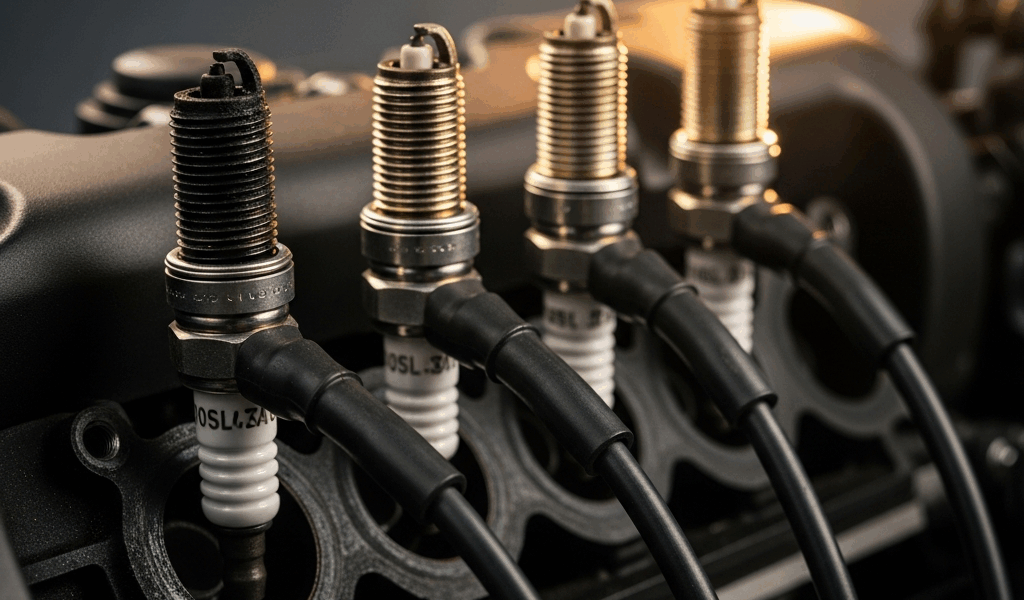
First, you should pull your spark plugs — at least if you haven’t touched them in the last 100 hours of run time. Marine plugs might be the best option to start with, as high-RPM troubleshooting requires ruling out the cheapest possible cause first. That is because a worn plug that fires just fine at idle will absolutely fail under load, when cylinder pressure spikes and the ignition system demands a strong, consistent spark.
I’m apparently sensitive to plug brands — NGK marine-grade works for me while generic hardware-store plugs never last a full season. Don’t make my mistake. The $2 knockoff plug is not saving you money.
When you pull them, look for:
- Fouling — heavy black or oily coating on the electrode. Carbon buildup is technically a fuel-delivery symptom, but it also makes the plug flat-out incapable of firing reliably under load.
- Gap wear — the electrode gap widens with use. Marine plugs need replacement around every 100–150 hours, which shakes out to roughly every 2–3 seasons depending on how hard you run.
- Corrosion or pitting — white, corroded electrodes mean the plug is done. No amount of gap adjustment saves it.
Replace them with OEM spec. Champion or NGK marine-grade for most inboard engines — around $8–15 per plug at West Marine or any decent auto parts counter. So, without further ado, let’s talk wires before you close everything back up.
Ignition wires take a beating in the marine environment. Salt air, heat, constant vibration — they crack and fail without making a sound. Run your fingers along the entire length of each wire and feel for cracks or splits. A compromised wire bleeds spark to ground instead of firing the plug. High RPM stresses the circuit harder than anything, so a marginal wire that seems fine at cruise will fall apart at wide-open throttle every time.
If the wires look borderline or they’re more than five years old, replace them. Marine wire sets run $40–80 depending on the engine. Honestly, if you’ve already got the plugs out, the wires are cheap insurance — just do it.
Check Your Fuel Delivery Under Load
Fuel delivery has gotten a bad reputation as a complicated diagnosis with all the fuel-injection systems flying around now. It doesn’t have to be.
A partially clogged fuel filter supplies enough flow for idle and moderate throttle. Fine. But at wide-open throttle, fuel demand spikes instantly — and a marginal filter can’t keep pace. The engine leans out. Misfire follows. This is probably the most common high-RPM misfire cause I’ve run into, and most people blame the carburetor or ignition first and skip right past it. Don’t.
Replace your fuel filter every season, or every 50 hours of hard running. Marine fuel filters cost $15–30. That’s it. Ethanol fuel absorbs water, breeds sediment, and clogs filters faster than they did 20 years ago — so the old “replace it every few seasons” advice is outdated.
If the filter is fresh and the misfire is still there, grab a fuel-pressure gauge — a basic marine gauge runs $20–40 at AutoZone or O’Reilly. Install it inline on the fuel-pump output line. At idle, you want steady pressure. At full throttle, it should hold constant within spec — typically 4–6 PSI for carbureted outboards, 35–45 PSI for fuel-injected engines. Pressure drops under load mean a dying fuel pump. Replace it. Pressure holds steady? Move on.
One more thing worth mentioning — vapor lock. In hot summer weather, fuel in the line can actually boil before it reaches the carburetor, creating an air pocket that starves the engine. If your misfire only appears in July and August at peak throttle when the engine compartment is hottest, vapor lock is a real possibility. Rerouting fuel lines away from heat sources can help, but that’s honestly territory where a marine mechanic earns their hourly rate.
Ignition Timing and the Distributor Cap
Retarded timing or a failing distributor cap — both will cause high-RPM misfires and both get overlooked constantly.
When timing drifts, the spark fires too late in the combustion cycle. At low RPM, the engine tolerates it. At high RPM, that error becomes critical fast. The spark can’t ignite fuel quickly enough to match what the engine demands. That’s your misfire.
Pull the distributor cap off and look inside. You’re looking for carbon tracking — black lines running across the cap interior where spark has been arcing around instead of traveling down the rotor the way it’s supposed to. A tracked cap gets replaced. Period. Marine caps run $30–60. Cracks anywhere on the cap are an obvious red flag too.
Timing itself is trickier. Older engines with mechanical advance need a timing light and a reference mark on the crankshaft — if you’re not comfortable there, skip it and call someone. Newer EFI systems handle timing electronically and rarely drift on their own. If timing is off on an EFI engine, you’re probably looking at a sensor problem rather than a mechanical one.
That said — if your engine is 15 years old or more and still carbureted, a distributor cap replacement is worth the $50 just to take it off the table.
When to Suspect Something More Serious
Probably should have opened with this section, honestly. Knowing when to stop saves real money.
If you’ve replaced plugs, wires, and the fuel filter and the misfire is still happening, something bigger is involved. Compression loss is one possibility. A failing coil pack on EFI engines is another. Stuck or clogged fuel injectors create misfires that vary with load and temperature in ways that no basic tune-up is going to fix — injector cleaner might mask it for a week, but that’s all it’s doing.
Here’s how you tell the difference. A misfire that gets worse over time, moves unpredictably between cylinders, or shows up alongside a rough idle at the dock — that’s probably not a spark plug. A wet compression test runs $50–100 at a marine shop and immediately tells you if you’ve got ring or valve damage. That was the test that finally told me my neighbor’s old Mercruiser had a cracked ring. Two seasons of parts swapping, solved in one afternoon.
For EFI engines specifically, a failing coil pack shows through cylinder-specific misfires that don’t improve no matter how many times you swap the plugs. That’s a distinctive pattern — and once you recognize it, you stop wasting money on plugs.
When you hit that wall — and you’ll know it when you do — call a marine mechanic. You’ve done the legwork. You’ve eliminated the basics. The diagnostic equipment required past this point isn’t realistic for a home garage.
Here’s your action plan. Plugs and wires first. Fuel filter second. Fuel pressure check third. Distributor cap visual inspection fourth. If all of that checks out clean and the misfire is still there, book a mechanic. You’ve already knocked out the $100 fixes. What’s left requires real tools and real experience — and at that point, handing it off is the smart move.



Stay in the loop
Get the latest nautical soundings updates delivered to your inbox.