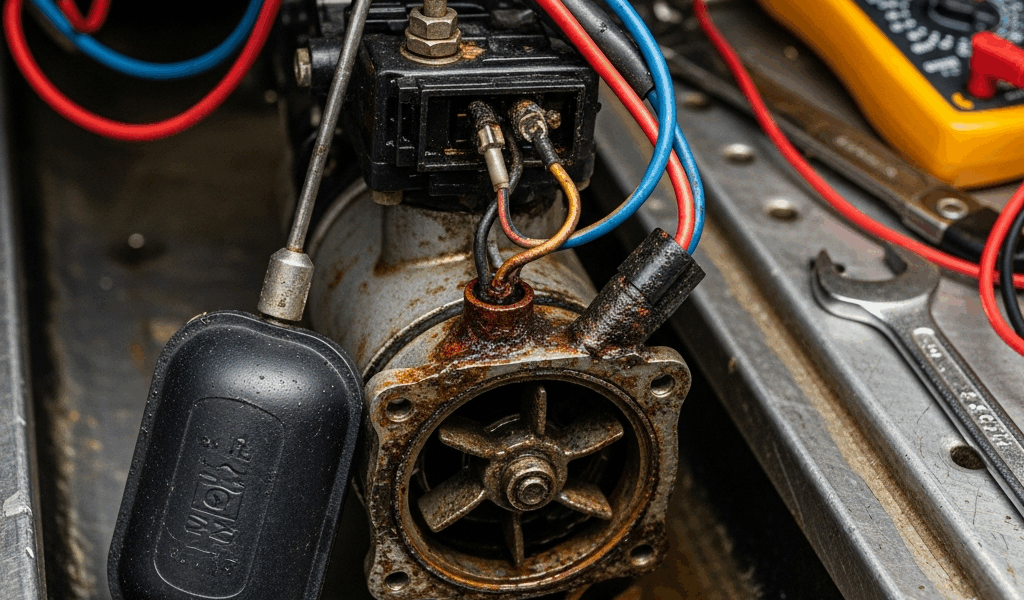
Why Your Bilge Pump Stops Working
Bilge pump troubleshooting has gotten complicated with all the “just replace it” advice flying around. I’ve stood in my cabin at 6 a.m. — three times over fifteen years, to be exact — listening to water slosh around down there instead of hearing that reassuring hum. The panic hits fast. Water intrusion is your boat’s slow enemy, and a dead bilge pump means you’re watching it win.
Here’s what actually matters: most failures fall into three buckets. Float switch. Wiring. Motor. In that order. A multimeter, a flashlight, and maybe thirty minutes gets you to the answer. Today, I will share it all with you — including the part most articles skip entirely.
That skipped part? The float switch. Sixty percent of these failures trace back to a $40 switch. Most guides jump straight to pump replacement. Don’t make my mistake — I paid $280 for a new pump once before finding a tiny piece of foam debris jamming my float in the down position. So, without further ado, let’s dive in.
Check the Float Switch First
Frustrated by rising water I couldn’t explain, I tore apart my bilge compartment using a basic penlight flashlight and an old multimeter I’d bought at Harbor Freight for $23. The culprit was sitting right there — a jammed float switch. It happens more than anyone admits.
But what is a float switch? In essence, it’s a mechanical sensor that activates when water rises in the bilge. But it’s much more than that — it’s the first line of defense between your boat and a slow sinking. It’s also the first thing that fails. Start here, always.
Manual Bypass Test
Disconnect the float switch wire from the pump. Find your boat’s 12V positive and negative terminals — usually on the main battery or a fused distribution panel. Connect the pump directly to 12V using jumper wires or temporary connectors.
Pump runs? Float switch is your problem. Stays silent? Move to the wiring section. Simple as that.
Testing the Float Switch with a Multimeter
Set your multimeter to continuity mode — the beeping setting, not voltage. Touch one probe to the switch terminal from the float mechanism, the other to ground. Raise the float by hand. You want a beep. Lower it, the beep should stop.
No beep when the float rises? Dead switch. Stuck in one position even when you physically move it? Corrosion or a mechanical jam inside the housing. I’m apparently sensitive to cheap marine components and Rule One hardware works for me while off-brand float switches never last a full season.
Marine-grade units run $35 to $80. Rule One makes solid ones. Attwood too. Installation takes fifteen minutes — at least if you’ve labeled your wiring beforehand, which, honestly, you should do anyway.
Common Float Switch Failure Modes
Debris jams the float in the down position. Hair, fishing line, bits of foam insulation — the float thinks there’s no water, so the pump never activates. That’s what makes bilge maintenance so endearing to us boat owners. It’s always something invisible causing the problem.
Corrosion around the mechanical pivot point is the second common failure. The float gets stuck halfway, or worse, stays permanently down. You won’t know until you physically move it by hand.
Water inside the float housing itself causes the float to sink instead of bobbing. Open the switch housing — if water pours out, that’s your answer. Replace it immediately.
A soft brush and white vinegar clears light debris. If the switch still binds after cleaning, replacement is the only real fix. There’s no patching a corroded pivot.
Inspect the Fuse and Wiring
Pump ran during the bypass test? Your float switch is probably fine. Electricity isn’t making it through the circuit in the first place.
Check Your Fuse or Breaker
Find the bilge pump circuit breaker or fuse holder. Most boats run either a 15-amp or 20-amp breaker on the bilge circuit. A blown fuse is obvious — the metal strip inside is broken or blackened. A tripped breaker feels different when you reset it. Clicks harder than normal. You’ll feel it.
Fuse keeps blowing or breaker keeps tripping? Something downstream is drawing too much current. Could be the motor failing. Could be a wiring short. Replace the fuse with an identical amperage rating — never oversized, never undersized. Ever.
Trace the Wiring for Corrosion and Loose Connections
Bilge wiring lives in genuinely awful conditions. Salt spray. Standing moisture. Diesel fumes. Corrosion at terminals isn’t exceptional — it’s standard. Plan for it.
Turn off the main battery. Disconnect the bilge pump circuit at the breaker. Then trace every wire from the float switch to the pump, checking each connection point:
- Float switch terminal — look for white or green corrosion crusting the copper
- Wiring run through the bilge — check for chafe where wire rubs against through-hull fittings or sharp edges
- Pump inlet connection — should be clean, tight, no gaps anywhere
- Ground return at the negative battery terminal — verify it’s not loose or corroded
Corroded terminals? Sand them with fine-grit sandpaper until the copper actually shines. Then apply dielectric grease — a thin coat. Reconnect and test. That alone fixes a surprising number of “dead” pumps.
Chafed wire with exposed copper? Wrap it with marine-grade electrical tape immediately, then reroute it away from whatever sharp edge caused the damage.
Check for Voltage Drop
With the bilge pump running — bypass it again if needed — measure voltage at the pump inlet while it’s pulling current. Then measure voltage at the battery terminals. The difference is your voltage drop. Should be under 0.5 volts.
More than that? Your wiring is undersized, corroded, or both. Replace it with marine-grade cable one gauge heavier than factory spec. For most 12V bilge pumps pulling 15 to 25 amps, 8-gauge wire is standard. That’s not a suggestion.
Test the Pump Itself
Bypass test passed. Wiring checks out. Now we’re looking at the pump motor itself.
Remove and Inspect the Impeller
Probably should have opened with this section, honestly — impeller inspection prevents half of these failures before they start. Most bilge pumps are cartridge-style or flexible-impeller units. Unbolt the pump from its mounting bracket. On flex-impeller designs, four bolts around the perimeter open the housing.
Look inside the impeller chamber. Hair. Fishing line. Foam bits. Small debris blocks water flow immediately — use needle-nose pliers to pull out anything that doesn’t belong. Takes two minutes.
The impeller blades should be intact. Cracked or melted blades mean the pump has been running dry or overheating. It won’t seal properly anymore. Replace the pump — not just the impeller.
Test Motor Draw and Output
Reconnect the pump to 12V power. Measure amperage draw while it’s running. A healthy bilge pump draws 15 to 25 amps depending on model and size. A Rule 500 pulls around 18 amps at full speed. A Flojet draws slightly less.
High amp draw — 40 amps or more — with no water output? Blocked impeller or failing motor. High draw generates heat fast. Shut it down immediately.
Dead silent with zero amp draw? Motor is seized or the windings are burnt. That’s a replacement, not a repair.
Normal amp draw, pump runs, but produces no flow? Internal blockage. Back to impeller inspection.
When to Replace vs. Repair Your Bilge Pump
A new bilge pump runs $150 to $400 depending on capacity and brand. A float switch costs $40 to $80. Wiring repair costs almost nothing but your time.
While you won’t need a full marine electrician, you will need a handful of tools — multimeter, wire stripper, dielectric grease, and marine-grade heat shrink connectors at minimum. First, you should assess pump age — at least if you want an honest repair-versus-replace decision. Eight years of bilge service is about the practical limit for most pump motors.
A new Rule 1100 pump runs $220. That’s less than most marina service calls. If the housing is cracked, replace the whole unit — internal corrosion is already spreading through components you can’t see.
Mercury tilt switches might be the best upgrade option, as bilge reliability requires consistent activation in rough conditions. That is because pendulum floats bounce around in heavy seas and trigger false readings — or worse, miss real ones. They cost $80 to $120 versus $40 for a standard float. Worth every dollar if you’ve had two float switch failures in three seasons.
Test your bilge system at the dock every season before the water warms up — not when you’re already taking on water at the stern. Flip the float manually. Listen for the hum. Watch the water level drop. That’s 1996-era advice that still holds. A working bilge pump remains your boat’s best defense against the kind of slow sinking that sneaks up on you overnight at the mooring.
Test manual and automatic pump operation before launch as part of the full spring boat commissioning checklist.




Stay in the loop
Get the latest nautical soundings updates delivered to your inbox.