Why Full Throttle Is the Key Clue
Outboard motor troubleshooting has gotten complicated with all the conflicting advice flying around. But here’s the thing — if your engine purrs at idle and completely falls apart at wide-open throttle (WOT), you’ve already done something useful. You’ve cut the suspect list in half. That’s a real win before you’ve touched a single bolt.
Idle operation asks almost nothing from your fuel and ignition systems. WOT demands everything, all at once. Fuel consumption spikes four or five times over. Ignition load peaks. Engine temps climb fast — we’re talking 200+ degrees in a matter of seconds. Any weakness hiding comfortably at cruise speed gets absolutely exposed at full throttle.
Three culprits cause this specific pattern: fuel starvation under high demand, ignition breakdown under load, and air or vacuum leaks leaning out the mixture. Each one has its own diagnostic path. Fix the wrong one and you’ve burned an afternoon for nothing.
Start With Fuel Delivery — Most Likely Cause
Fuel starvation is suspect number one in WOT sputtering cases. The engine’s appetite grows fast as RPM climbs — at 1,000 RPM it needs a trickle, at 5,500 RPM it needs a fire hose. Any restriction that barely whispers a problem at 2,000 RPM becomes a strangling blockage at wide-open throttle. Check these in order:
- Fuel filter. Cheapest culprit. Easiest fix. Pull the filter bowl or cartridge depending on your motor and look inside. Healthy media is white or light yellow. Black or dark brown means it’s packed with sediment. Replacement runs $15 to $40. Do this first — always.
- Primer bulb test. Squeeze the rubber primer bulb firmly with the engine off. It should feel firm and springy. Soft, collapsing, or stays collapsed? The fuel pump isn’t priming right. This is a five-second field test. A dead primer bulb almost always points to a failing fuel pump inside the motor.
- Fuel lines. Run your hand along the entire line from tank to engine. Pinched, kinked, or cracked lines choke fuel flow under demand — but often leave low-speed running barely affected. A complete replacement set costs $10–$25. Not expensive for what you get.
- Fuel cap vent. The cap has to vent air back into the tank as fuel leaves it. A clogged vent creates negative pressure and starves the engine at high demand. Sounds almost too simple, I know. But try this: remove the cap entirely and run the motor at WOT. Runs clean suddenly? The cap vent is your culprit. Replacement caps are $8–$20.
Also listen to the fuel pump at key-on, before starting. On modern EFI motors you should hear a brief electric whir as the pump primes — every single time you turn the key to run. Silence means the pump is dead. On older carbureted motors with mechanical pumps, the primer bulb squeeze tells you what you need to know.
Probably should have opened with this section, honestly. I’ve watched too many people tear apart carburetors when their actual problem was a $20 fuel filter or a vented cap that stopped venting.
Check the Carburetor or Fuel Injectors Next
Confirmed fuel is reaching the engine under load? Good. The sputter might still live inside the fuel delivery pathway itself.
Carbureted Motors
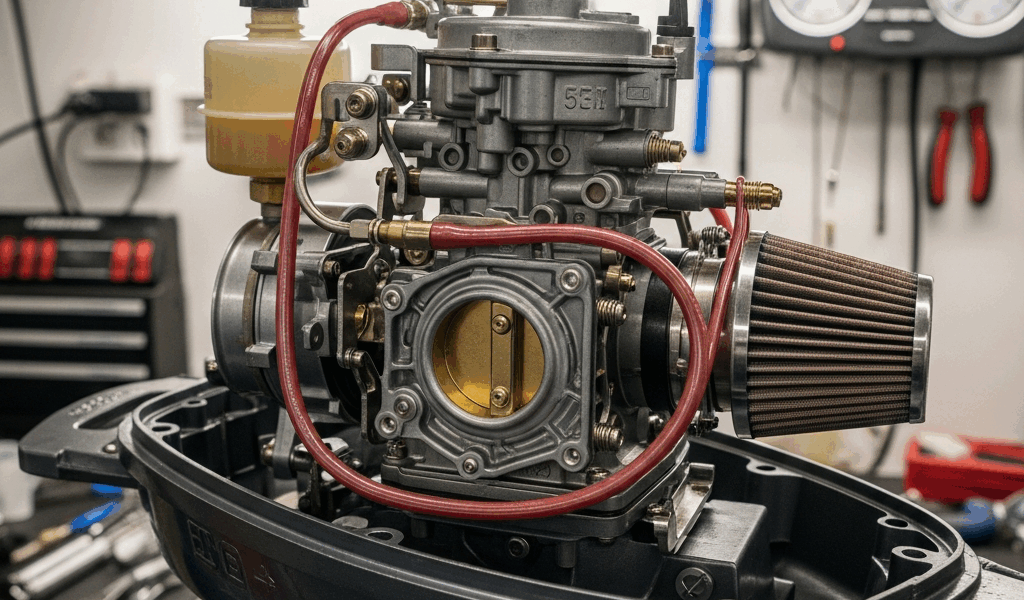
Frustrated by varnish buildup after a season of sitting, older carbureted outboards develop a very specific failure pattern — one that only shows up when you actually need the power. Here’s why: carbureted motors use two jet sizes. The pilot jet handles idle and low RPM. The main jet takes over at mid-throttle and dominates completely at WOT. A clogged main jet means the engine runs beautifully right up until the moment you crack it wide open.
A gummed main jet looks like a pinhole with brown crust around it. You’ll see it clearly under magnification once you pull the carb bowl. Fix it with carburetor cleaner and a soft brush — not a wire pick, which damages the orifice and turns a $0 cleaning into a $40 jet replacement. Soak the bowl in cleaner for 20 minutes, brush gently. If this is your first time doing it, budget 45 minutes. Second time takes maybe 20.
EFI Engines
Fuel-injected outboards use electronic injectors controlled by engine sensors. Dirty injectors cause the exact same WOT sputter. Fuel pressure also drops as RPM climbs when the pump is marginal — and a marginal pump feels fine at idle.
A healthy EFI system holds 40–60 PSI at idle and maintains that number at WOT, though specs vary by model. Pressure dropping below 35 PSI at high RPM means the pump is failing. A fuel pressure gauge runs $30–$80 to buy or rent. Connect it to the fuel rail test port, run the motor to WOT, write down the number. Show it to a marine tech if you’re unsure what’s normal for your specific engine.
Professional fuel system cleaning — a service that runs $150–$300 at a shop — often clears dirty injectors completely. That’s a much better outcome than a $400+ injector replacement you didn’t actually need.
Ignition Problems That Show Up Under Load
But what about spark plugs? In essence, they’re simple components. But they’re much more than that when heat enters the picture. A plug that fires perfectly at idle can misfire badly under the extreme heat and pressure of WOT — and you’d never know it without running the motor hard.
Pull the plugs and read them. A good plug shows light tan or gray deposits on the electrode. A fouled plug — black, wet-looking — suggests the engine is running rich, often from a fuel delivery issue upstream. A burnt plug — white, eroded electrodes, widened gap — means it’s been overheating. A gapped plug with an electrode gap of 0.040″ or wider, when spec calls for 0.030–0.035″, causes misfires under load. Don’t make my mistake of ignoring the gap because the plug “looked fine.”
Fresh plugs run $20 for most motors. You’ll know in five minutes on the water whether that solved the WOT sputter. It’s the cheapest experiment in this entire diagnostic process.
Ignition coils are trickier. A coil that works at idle can fail under peak RPM and temperature — thermal breakdown is real, and it mimics almost every other WOT symptom exactly. If new plugs don’t fix it and fuel delivery checks out, a failing coil is next. Swapping coils runs $50–$150 depending on how many cylinders your motor has. Older motors might have timing issues — a skip in the ignition timing curve that only appears at specific RPM ranges — but that’s rarer and honestly needs a timing light to diagnose properly.
When to Stop DIYing and Call a Marine Technician
I’m apparently someone who pushed DIY diagnosis one step too far more than once, and knowing when to stop works for me while guessing never does. So here’s the honest line: if you’ve cleaned the fuel filter, tested the pump and lines, checked the main jet or fuel pressure, swapped plugs, and the WOT sputter is still there — you’ve hit the limit of what field diagnosis can tell you.
Internal fuel pump failure, a bad injector on EFI motors, internal timing problems on modern engines, a failing ignition module — these need specialized tools and trained hands to confirm. A shop has fuel system analyzers, injector testers, and compression equipment that simply aren’t practical to own as a recreational boater.
That’s what makes doing your own preliminary diagnosis endearing to us DIYers — even when we hand it off, we hand it off with information. You can tell the technician exactly what you ruled out already. You’ve narrowed the problem from “outboard motor sputtering at full throttle” down to something specific: fuel is reaching the engine, plugs are new, but ignition or fuel atomization is still breaking down at WOT. That specificity alone saves you $100 in diagnostic time and gives the tech a map instead of a fog.
Walk in with a written list of what you’ve tested. You’ll get a faster diagnosis, a more targeted repair, and — almost always — a cheaper bill.



Stay in the loop
Get the latest nautical soundings updates delivered to your inbox.