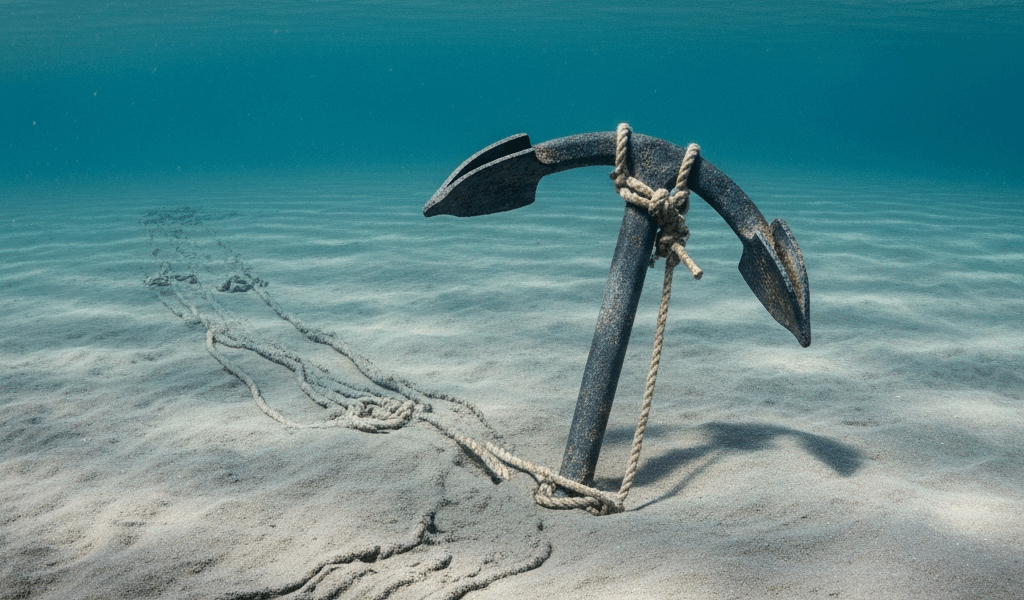
Start Here — Scope Is Almost Always the Real Problem
Boat anchoring has gotten complicated with all the gear recommendations and conflicting advice flying around. But honestly? Most dragging problems come down to one embarrassingly simple thing. I learned this after waking up at 2 AM, drifting past a mooring field, absolutely convinced my anchor was garbage. It wasn’t. I’d put out maybe 40 feet of rode in 12 feet of water and expected it to hold like a railroad spike in concrete. It did not.
So what is scope, exactly? In essence, it’s the ratio of how much rode you’ve deployed versus your total vertical distance from seabed to bow cleat. But it’s much more than a simple number — it’s the entire mechanical reason your anchor holds at all. The baseline is 7:1. Seven feet of line or chain for every foot of vertical distance. Most recreational boaters are out there running 3:1 or 4:1 without realizing it, because standing at the bow staring at water that “doesn’t look that deep” scrambles the math in your head every time.
Here’s the actual calculation:
- Measure water depth — use your chartplotter or depth sounder, not a guess
- Add freeboard, roughly 4–6 feet on a 30-footer from waterline to bow cleat
- Multiply that total by 7
Real example: 15 feet of water plus 5 feet of freeboard is 20 feet vertical. Multiply by 7. You need 140 feet of rode in the water. Most people throw out 60 feet and then write angry forum posts about their anchor brand. Don’t make my mistake.
The reason 7:1 actually works is something called catenary — the natural downward sag in chain or rope hanging under its own weight. That curve absorbs wind gusts and current shear, which keeps the pull on the anchor horizontal rather than yanking it straight up. At 3:1, you’ve got nearly straight-line tension. The anchor pops free the moment conditions stiffen. At 7:1, the curve does the work.
Probably should have opened with this section, honestly. Deploy more scope first. If you’ve got 60 feet of rode on a 30-footer, you’re underscoped every single time you anchor. This one fix solves maybe 70% of “my anchor won’t hold” situations — full stop.
Bottom Type Can Make Any Anchor Fail
Even with perfect scope, your anchor might not grip. That’s what makes bottom composition so maddening to diagnose — you did the math right and it still dragged. This is the second most common mismatch I run into, usually when boaters move from familiar inland anchorages to coastal areas with completely different seabeds.
Mud is the gold standard. A plow, a fluke, even a beat-up old Danforth will bury and hold in thick mud. Anchoring in the Chesapeake, the Gulf Coast, anywhere with silt buildup? Mud is your default assumption, and most anchors love it.
Sand is trickier. Fine, compacted sand sometimes behaves like mud — a fluke bites and sets cleanly. Coarse or loose sand is a different animal entirely. A plow anchor with a good shank angle outperforms a traditional fluke in loose sand because it drives deeper before sideways pressure pushes it out.
Grass and weed beds are the silent killers. A plow can nose into dense seagrass and then slide across the top like it’s on ice. A lightweight Danforth won’t punch through the mat at all. Anchoring around eelgrass, turtle grass, or kelp? Your standard fluke anchor is working against you. Roll-bar style anchors — the Rocna, the Mantus — drive through vegetation where a fluke just skids sideways and waves goodbye.
Rock and hard sand are the worst-case scenario. A Danforth fluke bounces off or slides along the surface. Even a plow struggles to dig in. Your best options are heavier overall weight and, sometimes, accepting you won’t get a true set. Some boaters add a kelp hook or rig a bridle to distribute force and increase friction rather than counting on penetration.
Regional patterns help enormously. New England and the Pacific Northwest — rocky. Chesapeake and Gulf Coast — mud and silt. The Bahamas — white sand. Florida — grass flats everywhere. Moving to a new cruising area? Ask marina staff or local boaters about the bottom before assuming your anchor will perform the same way it did back home.
Check Your Rode — Chain, Nylon, and the Connections Nobody Inspects
Rode configuration matters more than most boaters acknowledge, and that’s what makes it such a reliable failure point. Chain provides weight and catenary. Nylon absorbs shock and stretches under load. Problems show up when people mix them carelessly or assume they understand how the two work together.
All-nylon rode without any chain struggles in real wind. Nylon doesn’t sag decisively enough to give you useful catenary on its own. A minimum of 15 feet of chain — preferably 20 to 30 feet on anything between 30 and 40 feet — creates the weight foundation that the nylon then extends. That chain lies on the seabed and handles the heavy lifting. The nylon above it manages stretch and shock load. Both jobs matter. Neither rope nor chain does both well alone.
The shackle connecting your anchor to the chain is a failure point that almost nobody inspects until something’s already gone wrong. A loose shackle pin can back out underway, leaving your anchor hanging by the shank. Tighten it with an actual wrench and lock the pin with seizing wire or a cotter pin. Check it at the start of each season and after any hard set where you felt the anchor really dig.
Catamarans, or any boat anchoring off a single bow cleat, benefit from a bridle rig — running chain or rode from each hull to a central knot, then down to the anchor. It distributes load across both hulls instead of stressing one point. Not standard on monohulls, but essentially mandatory on cats in anything above light air.
Inspect your rode annually for chafe, especially at chocks and fairleads. A damaged nylon section can part explosively under load. A kinked or rusted chain link — even one — can snap. These aren’t dramatic failures right up until they are, at 0300, in 25 knots of wind.
How Wind Shifts and Current Changes Reset a Perfectly Set Anchor
An anchor holding solidly at 6 PM can drag at 2 AM when wind direction rotates 30 degrees or gusts jump by 10 knots. This trips up experienced boaters. It isn’t anchor failure — it’s geometry.
When your anchor sets, the flukes bury in a specific direction under a specific load vector. That’s it. That’s the whole deal. A wind shift changes that vector. The anchor doesn’t rotate and re-orient automatically. It just experiences sideways pressure until the shank bends enough to lever the flukes out — and then you’re dragging across the anchorage at midnight.
Current changes work identically. I was anchored on a tidal river once, current reversed with the tide around 0100, and I woke up pointed completely backward with the anchor skipping across sand like a flat stone. The anchor hadn’t failed. The load direction had rotated 180 degrees and the anchor hadn’t reset to match.
After any significant weather change or noticeable wind shift, consider resetting manually. Motorsail upwind or uptide until your rode goes nearly vertical, feel the anchor break free, then back down hard to reset it in the new direction. Fifteen minutes of annoyance beats a 3 AM adrenaline emergency. That’s what makes proactive resetting so endearing to us anchoring obsessives — it’s boring, unglamorous, and it works every time.
When the Anchor Itself Is Actually the Problem
Only after you’ve confirmed scope is right, identified your bottom type, and inspected your rode should you start blaming the anchor design. In that order. Skipping ahead wastes money.
Fluke anchors — Danforth-style, like a Standard 22-S or a Fortress FX-23 — work extremely well in mud and soft sand. Light, affordable, easy to stow flat. They fail in grass, rock, and heavy clay. A 25-pound fluke won’t reset after a wind shift on hard sand the way a 35-pound plow will. I’m apparently a fluke anchor skeptic at this point, and the Fortress works for me in Gulf Coast mud while the old Danforth I inherited never reset reliably in anything firmer.
Plow anchors set faster and reset better during wind shifts because they naturally rotate to align with load direction. Heavier and pricier — a CQR 45-pound runs around $300 to $400 used. They don’t hold as well as flukes in very soft mud, but they’re genuinely more versatile across mixed bottom types.
Roll-bar anchors — the Rocna, Mantus, or Spade — combine the best attributes. Fast setting, solid wind shift performance, decent mud grip, improved grass penetration. They cost more than plows and take more deck space. A Rocna 20 runs close to $500 new. But for cruisers who move between multiple bottom types, the versatility is worth the price.
So, without further ado, here’s the actual decision framework: confirm 7:1 scope first. Identify your bottom type second. Inspect chain, shackles, and rode third. If all three check out and you’re still dragging, then — and only then — does anchor weight and design become the conversation. Move up one size in whatever style matches your primary anchorages, or switch designs entirely if your cruising area’s bottom type has changed. In that sequence, not before it.


Stay in the loop
Get the latest nautical soundings updates delivered to your inbox.