Outboard Motor Surging at Idle — What Causes It and How to Fix It
Outboard motor surging at idle has gotten complicated with all the guesswork and forum noise flying around. As someone who’s been diagnosing small engines and marine powerplants for going on eighteen years, I learned everything there is to know about that maddening hunt-and-surge pattern — the RPMs climbing, dropping, climbing again, sometimes stalling out entirely at the dock. It feels like the motor genuinely can’t decide what it wants to do. Frustrating on a calm day. Genuinely alarming when you’re fighting a current and need the engine to just hold.
Before you pull the carburetor apart or start ordering sensors online at midnight, read this first. Most fixes here cost less than $20 and an afternoon. I’ve watched people hand over $400 at a shop for a problem that needed a $3 inline fuel filter and five minutes with a can of carb cleaner. Don’t make my mistake — or theirs.
The Three Most Common Causes of Idle Surge
Roughly 80% of idle surge complaints I see trace back to one of three things: fuel restriction, a dirty pilot jet, or an air leak somewhere in the fuel delivery system. That’s it. Rule all three out and the motor is still surging? Then we start getting into less common territory. But start here. Always start here.
Fuel Restriction
A clogged fuel filter starves the carburetor at idle far more noticeably than at wide-open throttle. At higher RPMs, the engine pulls fuel hard enough to push past mild restriction. At idle, demand is low and inconsistent — so restriction shows up immediately as that hunting surge pattern.
Check the inline fuel filter first. Hold it up to light. You should see clearly through it. Any discoloration, debris, or clouding means replacement. A Moeller 15-micron inline filter runs about $8 at most marine supply stores. Just replace it. Don’t bother trying to clean them — it’s not worth the effort for $8.
Also check the fuel tank vent. This one bites people constantly and it’s almost embarrassingly simple to miss. A blocked vent creates a vacuum inside the tank as fuel gets consumed. The engine draws normally for a while, then the vacuum causes fuel starvation — and you get the surge. The fix is sometimes as simple as loosening the gas cap. I’ll explain exactly how to test for this below.
Dirty Pilot Jet
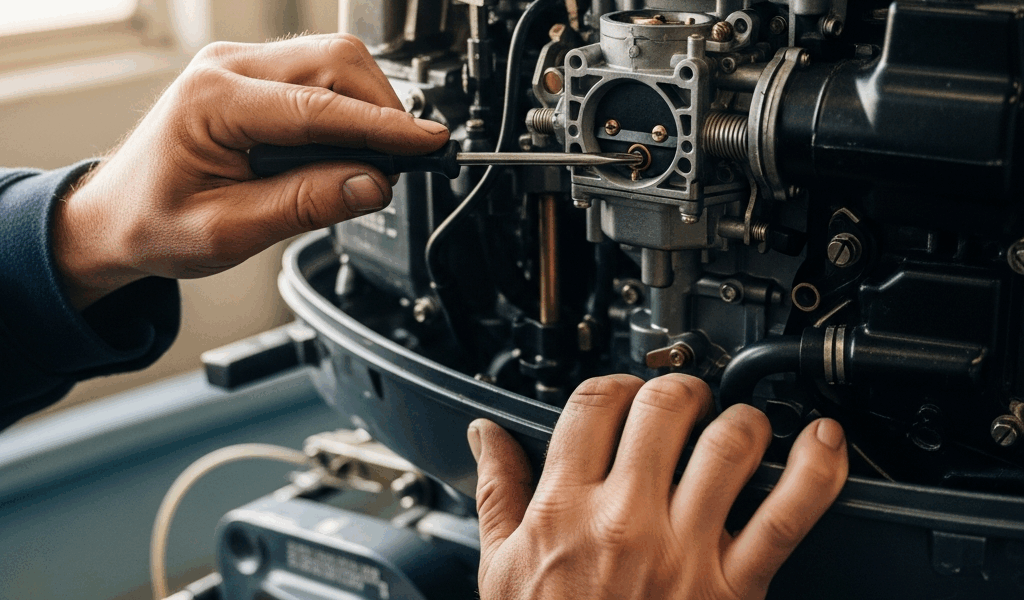
But what is a pilot jet? In essence, it’s a small brass jet inside your carburetor — sometimes called the slow jet — that controls fuel delivery at idle and low throttle positions. But it’s much more than that. It has a tiny orifice, usually somewhere between 0.3mm and 0.6mm depending on the engine, and ethanol-blended fuel leaves behind varnish deposits that partially block that hole. Partial blockage at the pilot jet produces a textbook surge at idle.
This is the single most common cause I see on carbureted outboards that spent a winter sitting without being fogged or drained. The main jet stays cleaner because fuel moves through it faster. The pilot jet just sits there — slowly gumming up.
Air Leak in the Fuel Line
A cracked primer bulb, deteriorated fuel line, loose clamp fitting — any of these introduces inconsistent air into the fuel mix. The carburetor float bowl level drops and rises erratically, and the engine surges trying to compensate. Squeeze the primer bulb and watch it. A bulb that feels mushy or won’t hold firm pressure has a crack or check valve failure. Sierra makes a decent replacement bulb assembly for about $12 to $18 depending on diameter.
Run your hand along every inch of fuel line from tank to engine. Look for cracks, brittleness, abrasion points. Old rubber line gets hard and develops micro-cracks you can’t always see — but you can find them by gently flexing the line while the motor idles.
Quick Diagnostic — Is It Fuel, Air, or Ignition
Probably should have opened with this section, honestly. Before doing anything else, run through these checks in order. They take maybe fifteen minutes total and will tell you exactly where to focus.
Step One — The Fuel Cap Test
Start the motor and let it surge. Then loosen the fuel cap completely — just crack it open about a half turn. Wait ninety seconds. If the surge improves or stops entirely, your tank vent is blocked. Clean or replace the vent fitting. Done. Go fishing.
Step Two — Watch the Fuel Filter for Bubbles
If you don’t have a clear inline filter, install one temporarily just for diagnostics. A clear filter lets you watch the fuel supply in real time — bubbles moving through while the motor runs mean air is entering the fuel system somewhere between the tank and the filter. Steady fuel with no bubbles means the line from the tank forward is intact, and your problem is downstream, likely at the carburetor or primer bulb.
Step Three — Pull the Spark Plugs
Pull the plugs after running the motor until it surges. A plug that’s wet with fuel or fouled black and sooty suggests the carburetor is running rich — too much fuel, not enough air. A plug that’s white or very light tan suggests lean running — too much air, not enough fuel. Both conditions can cause surge. Wet, fuel-fouled plugs on a carbureted engine usually point to a stuck float or leaking needle valve. Light, lean-looking plugs point back to the fuel restriction or air leak causes we already covered.
Step Four — Check for Vacuum Leaks at the Intake
With the motor idling, spray a small amount of WD-40 or carb cleaner around the carburetor base gasket and intake manifold while watching your tachometer or listening for RPM changes. If the RPM suddenly shifts when you spray a particular spot, you’ve found an intake air leak. Replace the gasket. This is a common failure on older Johnson and Evinrude two-strokes from the mid-1990s especially — those base gaskets get brittle and crack without much warning.
Carburetor-Specific Fixes
If the quick diagnostic points to the carburetor, here’s how to address it without buying a new one immediately.
Pilot Jet Removal and Cleaning
Remove the carburetor from the engine — usually two or four bolts, a fuel line, and a throttle linkage clip. On a single-carb engine like a Mercury 25hp or a Yamaha 40hp four-stroke, this takes about twenty minutes. With the carb on a clean bench, locate the pilot jet. It’ll be a small brass plug with a hex head, typically inside the bowl area near the main jet. Remove it carefully — these are soft brass and strip easily if you use the wrong screwdriver size.
Hold the pilot jet up to a bright light and look through the orifice. You should see light through a perfectly round hole. Any debris, varnish cloudiness, or partial blockage means cleaning is needed. Soak it for thirty minutes in Berryman B-12 Chemtool or a similar carburetor soak, then follow with compressed air blown directly through the jet orifice. Never use wire or drill bits to ream out the hole — ever. You’ll enlarge it and permanently alter the fuel mixture.
Idle Mixture Screw Adjustment
The idle mixture screw controls the air-fuel ratio at idle. On most outboard carburetors, it’s a tapered needle screw on the side of the carb body — often under a pressed-in plug on newer models for EPA compliance. The standard starting point is 1.5 turns out from lightly seated. Adjust in small quarter-turn increments while the engine idles, listening for the highest, smoothest RPM. Then use the idle speed screw to bring RPM back to your target — typically 650 to 750 RPM for most outboards in neutral.
Frustrated by carb adjustments that never hold? The mixture screw O-ring is probably worn. A new O-ring on that screw is a $1 fix that makes the adjustment hold properly. I learned this the hard way after spending forty-five minutes tuning a Yamaha 50hp carb only to have it surge again the next morning. That’s what makes the O-ring such an endearing little part to us shade-tree marine mechanics — it costs almost nothing and fixes everything.
Rebuild vs. Replace
Rebuild kits for most common outboard carbs run $15 to $35. A new OEM carburetor for something like a Mercury 4-stroke 60hp runs $180 to $280. If the carb body is cracked, the throttle shaft is worn and sloppy, or you’ve cleaned it twice and the surge keeps coming back — buy the new carb. Otherwise, a rebuild with fresh gaskets, needle valve, and float is usually worth doing first.
Fuel-Injected Outboard Surge — Different Causes
Modern four-stroke outboards from Yamaha, Honda, Mercury Verado, and Suzuki use electronic fuel injection. Carb cleaning doesn’t apply here. The surge diagnosis is a different process entirely.
Throttle Position Sensor
The throttle position sensor tells the ECU where the throttle is at any given moment. A worn or faulty TPS sends erratic signals — and the ECU adjusts fuel delivery accordingly, which you feel as surge. Yamaha F150s and F200s are known for TPS issues after about 500 hours of use. The sensor itself typically runs $60 to $120. Diagnosis requires an OBD-style marine scanner or a dealer with Yamaha Diagnostic System software.
Fuel Pump Pressure
EFI outboards need consistent fuel pressure — typically 36 to 43 PSI depending on the system. A failing low-pressure lift pump or high-pressure fuel pump causes lean conditions at idle identical to what a dirty carb causes on older engines. Test with a fuel pressure gauge. Any reading that fluctuates more than 2 PSI during idle surge is pointing directly at pump wear or a clogged fuel pressure regulator.
Injector Cleaning
Partially clogged injectors cause lean misfire and surge on EFI outboards the same way a dirty pilot jet does on carbureted ones. Sea Foam Marine Pro added to the fuel tank addresses mild deposits over time. For significant buildup, professional ultrasonic injector cleaning runs about $20 to $30 per injector at a fuel injection specialty shop — much less than new injectors, which can run $80 to $150 each depending on the engine.
When It’s Beyond DIY — What a Marine Mechanic Charges
Some things belong in a shop. Knowing which ones saves time and prevents turning a minor problem into an expensive one.
Typical Diagnostic Fees
Most marine shops charge $95 to $150 for a diagnostic hour. A good tech should identify the cause of idle surge within that first hour in the majority of cases. Ask upfront whether the diagnostic fee gets credited toward the repair if you proceed — many shops do this, and it’s worth knowing before you hand over the keys.
Common Repair Costs
- Carburetor clean and rebuild — $120 to $220 labor plus $15 to $35 parts
- Carburetor replacement — $150 to $250 labor plus $180 to $300 parts
- Fuel line replacement — $80 to $150 depending on engine size and access
- TPS replacement on EFI outboard — $100 to $180 labor plus $60 to $120 parts
- Fuel pump replacement — $120 to $200 labor plus $80 to $250 parts
Signs the Problem Is Beyond Home Repair
Take it to a shop when the surge comes with smoke, when the motor stalls every single time at idle rather than just hunting, when you’ve cleaned the carb twice and the problem returned within a season, or when a fault code is stored and you don’t have the scanner to read it. Also — if the surge is present across all RPM ranges and not just at idle, that shifts the diagnosis significantly toward compression issues, ignition problems, or internal damage. Those need proper testing equipment and real diagnostic experience behind them.
Idle surge is almost always a solvable problem. Work the diagnostic steps in order, resist the urge to start swapping expensive parts randomly, and most of the time you’ll find a $10 fix waiting at the end of a twenty-minute check. The motor isn’t broken — it’s just asking for something specific. Figure out what that is, and it’ll run clean.



Stay in the loop
Get the latest nautical soundings updates delivered to your inbox.