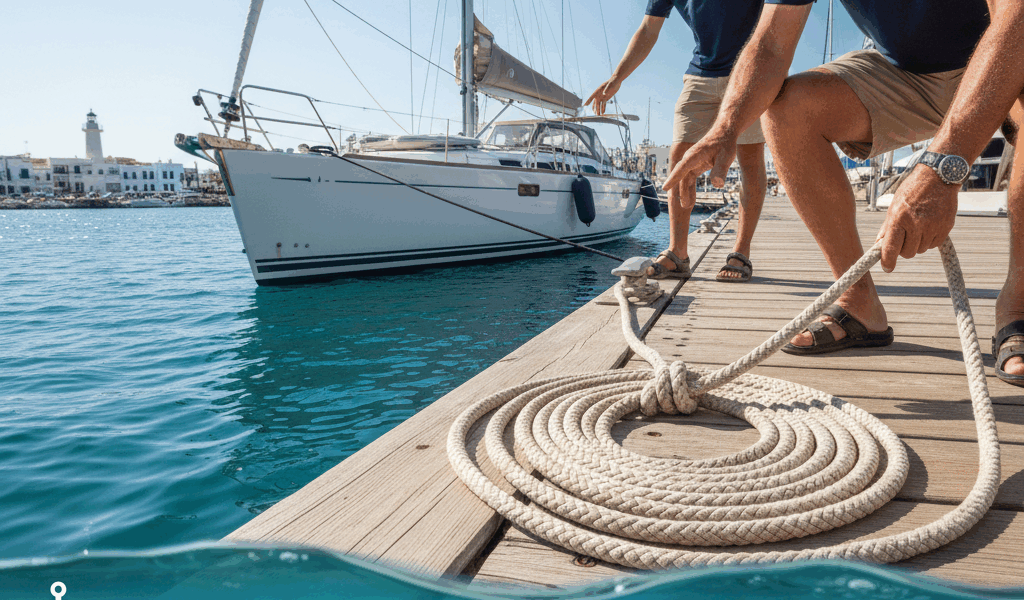
Understanding Your Dock Lines
Dock line handling has gotten complicated with all the different techniques, materials, and marina configurations flying around. As someone who’s docked in hundreds of slips across the East Coast, I learned everything there is to know about making these maneuvers look easy. Today, I will share it all with you.
A standard docking setup uses four primary lines, each serving a distinct purpose. Bow lines run from the forward cleat to the dock, preventing the boat from drifting backward. Stern lines perform the opposite function, keeping the boat from moving forward. Spring lines are the unsung heroes of docking, running diagonally to control fore-and-aft movement. A forward spring runs from the bow area aft to the dock, while an aft spring runs from the stern area forward.

Proper Line Handling Techniques
Probably should have led with this section, honestly. Before approaching the dock, prepare your lines by flaking them on deck in figure-eight patterns. This prevents tangles during those critical moments when timing matters most. Never coil lines in tight circles, as this introduces twists that cause kinks at the worst possible times.
When tossing a line to dock hands, throw from the hip with an underhand motion, aiming slightly past your target. The line should uncoil smoothly without catching on deck hardware. Keep the bitter end secured to a cleat on your boat before throwing to ensure you maintain control regardless of what happens ashore.
Train yourself to handle lines with confidence rather than haste. Smooth, deliberate movements prevent mistakes that jerky, panicked actions inevitably create. That’s what makes good line handling endearing to us boaters — it shows experience without showing off.
Cleating and Securing Lines
Proper cleating technique ensures your lines hold securely without jamming. Start by taking a complete turn around the base of the cleat, then make alternating figure-eight turns over the horns. Finish with a half-hitch around one horn to lock everything in place. The rule of thumb is one base turn plus three figure-eights plus one locking hitch.
Avoid the common mistake of piling excess line on the cleat. Too many turns create a tangled mess that becomes nearly impossible to release quickly in an emergency. Keep your cleating clean and efficient.
Adjusting for Tides and Conditions
Static line lengths work fine in fresh water, but tidal areas demand attention to changing water levels. In locations with significant tidal range, allow enough slack in your lines to accommodate the full swing without leaving the boat too loose at high tide.
A useful method involves setting lines at mid-tide length, then adjusting based on your planned duration. For overnight stays, calculate the maximum tidal change and add appropriate slack. Spring lines help here because their diagonal angle provides more natural accommodation for vertical movement than perpendicular bow and stern lines.
Spring Line Techniques for Docking
Spring lines prove invaluable during docking maneuvers, particularly when single-handing or dealing with challenging conditions. The spring line pivot technique allows you to swing your boat into a slip using engine power against a secured spring line.
To execute this maneuver, secure a forward spring from your midship cleat to a dock point roughly even with your bow. With the engine in forward gear at idle, the spring line prevents forward movement while prop thrust pushes the stern toward the dock. This technique works especially well in tight quarters where traditional approaches prove difficult. I use it constantly.
Line Material Selection
Modern dock lines come in several materials, each offering distinct advantages. Three-strand nylon remains the most popular choice for recreational boaters due to its excellent stretch characteristics, which absorb shock loads from wave action and wakes. Nylon also offers good abrasion resistance and remains affordable.
Double-braided nylon provides similar stretch with a smoother hand and better appearance. Though more expensive, many boaters prefer its handling characteristics and reduced tendency to kink.
Polyester lines stretch less than nylon, making them better suited for applications where minimal movement is desired. However, this reduced stretch means they transmit more shock loads to cleats and hardware.
Choose line diameter based on your boat size: 3/8-inch for boats under 25 feet, 1/2-inch for 25-35 feet, and 5/8-inch or larger for vessels exceeding 35 feet.
Chafe Prevention
Chafe destroys more dock lines than age or UV exposure combined. Wherever lines contact chocks, railings, or rough dock surfaces, friction gradually wears through fibers until failure occurs. Inspect your lines regularly at contact points, rotating or repositioning them periodically to distribute wear.
Chafe guards made from leather, canvas, or reinforced tubing provide excellent protection at known wear points. Some boaters wrap problem areas with rigging tape as a temporary solution, though proper chafe gear offers superior durability.
Consider using snubbers on anchor rodes and dock lines in areas subject to surge or heavy wave action. These shock absorbers reduce peak loads on both lines and deck hardware while extending equipment life.
Final Thoughts
Mastering dock line handling transforms marina visits from stressful events into routine operations. Practice these techniques in calm conditions until they become second nature. When challenging situations arise, your muscle memory and knowledge will guide you through confidently.


Stay in the loop
Get the latest nautical soundings updates delivered to your inbox.