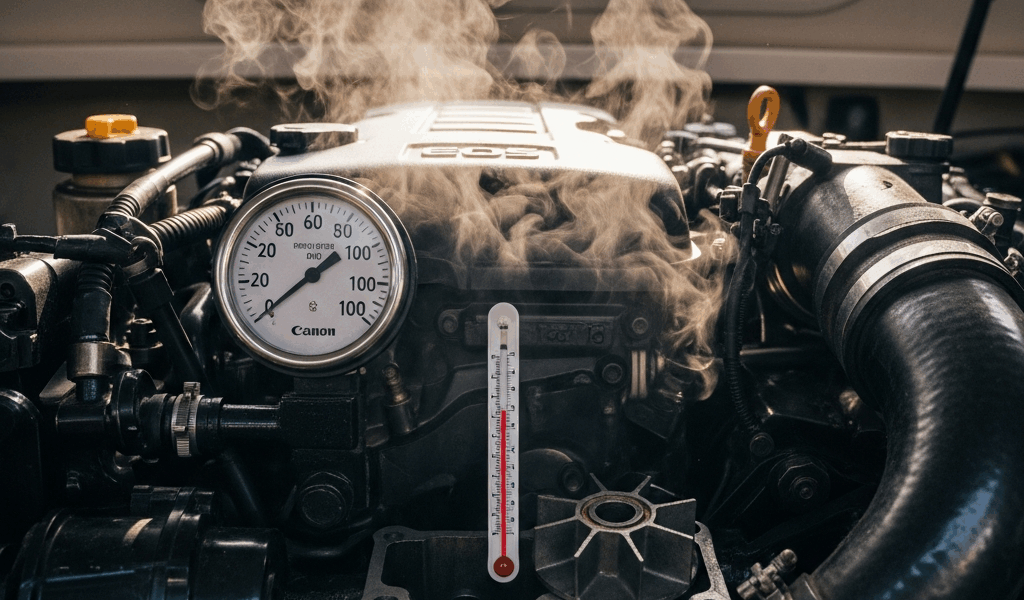
First Thing to Do When Your Temp Gauge Spikes
Boat engine overheating has gotten complicated with all the conflicting advice flying around. As someone who’s watched that needle creep into the red — twice, on open water, with no marina in sight — I learned everything there is to know about what actually matters in those first sixty seconds. Today, I will share it all with you.
So, without further ado, let’s dive in. The move is this: throttle back to idle. Not a full shutdown. Not yet. A spike that settles after you back off is a completely different animal from one that keeps climbing even at idle. Know the difference before you do anything else.
While you’re at low throttle, find the telltale stream — that thin jet of water discharging from the side of your engine block or transom. On my 2007 Yamaha F150, it sits right at the corner where the engine meets the transom. If water’s flowing steadily from that spot, the engine isn’t running dry. You have a moment to think.
No telltale stream? That’s your red alert. Shut down immediately. Running a water-cooled engine without cooling flow will trash the head gasket in seconds flat and warp the cylinder head in minutes. The difference between stopping now and pushing through is roughly $2,000 to $8,000 in repair bills — depending on your engine. Don’t make my mistake from that first time out.
Temperature still climbing despite a visible stream? Move to the diagnostics below. You have time, but not a lot of it.
Overheating at Idle vs Overheating at Speed
This is the diagnostic split that separates a quick fix from a three-week nightmare at the marina — and most generic advice skips it entirely. But what is this distinction, exactly? In essence, it’s about when the overheat happens relative to your throttle position. But it’s much more than that.
Engine Overheating Only at Idle
Temperature climbs the moment you drop to idle, then stabilizes or even dips when you’re back under load? You’ve narrowed it down. Two likely suspects: the water pump impeller or a partial blockage somewhere in the cooling circuit.
At idle, cooling flow runs at its absolute minimum. A damaged impeller or any partial obstruction becomes obvious because there’s barely enough flow to work with in the first place. Throttle up, and raw water pressure increases enough to sometimes push past a small clog or compensate for a worn-out impeller. That’s why the problem hides at speed and shows itself at idle.
Start with the impeller — always. I cover that in detail below. If it checks out fine, suspect debris: sand, scale, or loose chunks of degraded rubber lodged in the intake screen or heat exchanger passages.
Engine Overheating at Speed
Temperature climbing steadily as you accelerate or hold cruise speed points somewhere else entirely. A thermostat stuck in the closed position. A restriction that only matters when the engine is working hard and cooling demand is at its peak.
A stuck thermostat won’t open wide enough to allow full flow through the heat exchanger when the engine needs it most. A collapsed or kinked raw water hose behaves almost identically — water moves fine at low demand, then gets choked off under pressure. Both scenarios look the same on your gauge. The impeller is almost never the culprit here. The blockage is downstream, and it only reveals itself when demand spikes.
The Most Common Culprit Is Probably the Impeller
Frustrated by an overheat event on a Saturday morning, I hauled out at Riverside Marina and pulled the water pump cover myself. The impeller was shredded — and I mean genuinely shredded. Three of the six rubber fins had completely disintegrated. That was 2019. I hadn’t replaced it in four seasons. Entirely my fault.
But what is an impeller? In essence, it’s a rubber-bladed wheel inside the water pump that physically pushes raw water through the cooling circuit. But it’s much more than that — it’s also one of the few wearing parts on a marine engine that will absolutely fail silently until it doesn’t. Every 300 to 500 running hours, the rubber degrades. That’s not a maybe. That’s physics.
Here’s what failure actually looks like: fins tear, crack, or harden with age. Pieces break free and float downstream, getting sucked into the thermostat housing or heat exchanger passages. Now you’ve got two separate problems from one failed $90 part. Fun.
To check the impeller without hauling the boat, remove the water pump cover — usually four bolts on the engine block side. On a Mercury or Yamaha, this takes maybe ten minutes with a basic socket set. Spin the impeller by hand. It should rotate smoothly. Fins should be intact and flexible, not brittle or split at the base.
Discolored fins? Totally normal. Chunks missing? New impeller, full stop. Replacement impellers run $35 to $120 depending on make and model. OEM Yamaha impeller runs around $90. Aftermarket versions hover around $40 — I’m apparently someone who learned the hard way that cheap aftermarket rubber never lasts as long, and OEM works for me while the bargain versions never quite do.
When you swap the impeller, flush the cooling circuit with fresh water or a dedicated flushing kit. Don’t just bolt the new part in and assume the debris cleared itself. It didn’t.
Other Causes That Get Overlooked
Beyond the impeller, a few other culprits hide in plain sight. That’s what makes troubleshooting marine cooling endearing to us boat owners — it’s always something obvious in retrospect.
Thermostat stuck closed. The engine runs progressively hotter because the thermostat won’t open and allow coolant through the heat exchanger. Shows up hardest at speed, when cooling demand peaks. Replacement thermostats are cheap — $30 to $80 — but diagnosis means pulling the housing off, which requires someone comfortable with the process or a mechanic who is.
Debris in the intake strainer. Grass, sand, small sticks — anything can clog the screen sitting upstream of the water pump. The fix is straightforward: pull the strainer basket, clean it out. I’ve pulled enough lake weed from mine to fill a five-gallon bucket. More than once.
Collapsed raw water hose. The rubber hose bringing water from the hull fitting weakens over years and pinches closed under pressure. Engines older than ten years are especially prone to this. The hose looks completely fine from the outside but collapses internally — you’d never catch it without pulling the hose and inspecting it. Replace with marine-grade hose rated for your engine’s pressure spec, usually around 50 PSI.
Low coolant on freshwater-cooled engines. Larger engines sometimes run a freshwater cooling loop with a separate heat exchanger. Low coolant causes cavitation and kills cooling effectiveness fast. Top it off with a 50/50 coolant-water mix and check every hose connection for leaks before you run it again.
How to Know If the Damage Is Already Done
Probably should have opened with this section, honestly. Knowing the damage assessment upfront keeps people from turning a small problem into a catastrophic one.
After an overheat event, resist every instinct to restart immediately. Wait ten minutes minimum. Let everything cool down before you touch the key.
Then check these things before cranking:
- Exhaust smoke on startup. Thick white smoke means coolant is leaking into the combustion chamber. Failed head gasket. Don’t run it — call a mechanic.
- Oil on the dipstick. Pull it, smell it. Coolant smell or milky appearance means water has mixed with the oil. A crack or failed head gasket is letting coolant into the crankcase. Do not run this engine.
- Rough idle or sudden power loss. A damaged or warped head throws off combustion and compression. Usually pairs with white exhaust smoke. Needs professional attention — not something to diagnose dockside.
- Overheating again within minutes of restart. You replaced the impeller and the temperature spikes again immediately? Something else is wrong upstream or downstream. Stop. Diagnose further. Running it won’t fix it.
The honest reality: most overheat events cause zero permanent damage if you catch them within the first few minutes. Shut down, cool it down, check the impeller, replace it if needed, and you’re back on the water by next weekend. Run a hot engine for thirty minutes straight — that’s a $5,000 head gasket job and three weeks waiting on a shop appointment.
Going forward, replace your impeller every season if you boat regularly. Every two years at the absolute minimum, even if your hours are low. A $90 part beats a $5,000 repair bill every single time. Don’t make my mistake.



Stay in the loop
Get the latest nautical soundings updates delivered to your inbox.