Your boat engine is making a sound it did not make last week. Before you assume the worst, note exactly when the knock happens — at startup, under load, at a specific RPM range, or constantly. When the knock occurs tells you more about the cause than the sound itself.
Knock Type Identification: When It Happens Matters Most
Knock only at startup that disappears after warmup: likely cold start knock. This is normal in some engines and caused by carbon buildup in others. Usually not serious. The engine’s tolerances are tighter when cold, and components expand to their operating clearances within a few minutes.
Knock appearing under load: bearing or rod issue. This is serious. The knock gets louder when you push the throttle and quieter at idle. Do not ignore this — running an engine with a bearing knock under load accelerates the damage from repairable to catastrophic.
Knock at a specific RPM range, often between 2,000 and 3,000 RPM: loose exhaust heat shield or mounting hardware. Not serious, easy to fix. The vibration hits a resonant frequency at that RPM band and produces a metallic rattle that sounds like an internal engine problem but is not.
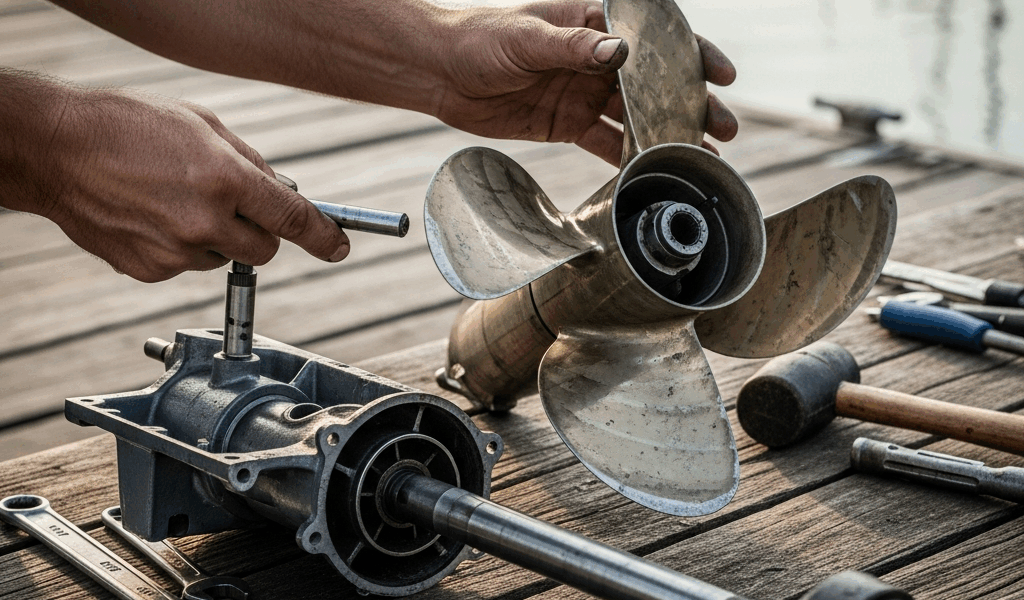
Knock with vibration through the steering or hull: prop strike damage. The prop hit something underwater and now has a bent blade or a separated hub. Requires prop inspection and likely repair or replacement.
Rod Knock: The Serious One
Rod knock is deep, rhythmic, and timed directly to engine RPM. Speed up the engine, the knock speeds up. Slow down, it slows down. The sound comes from the lower end of the engine — worn connecting rod bearings that have developed excessive clearance between the rod and the crankshaft journal.
Causes: oil pressure failure, running with low oil level, or high-mileage bearing wear. The bearing surface wears away, clearance increases, and the rod slaps against the crank journal on every revolution.
If you suspect rod knock, shut down immediately. Running a rod-knock engine destroys the crankshaft, the rod, and potentially the cylinder wall. What could have been a bearing replacement becomes a complete lower-end rebuild or engine replacement.
To confirm before teardown: send an oil sample to Blackstone Laboratories or a similar oil analysis service. Worn bearings shed copper and lead particles that show up in the analysis. A $30 oil test can confirm the diagnosis before you commit to a $2,000 repair.
Piston Slap and Cold Start Knock
Piston slap is a hollow, slapping sound that reduces or disappears as the engine reaches operating temperature. The piston rocks slightly in the cylinder bore when cold because the bore has worn slightly larger than specification. As the piston expands with heat, the clearance closes and the slapping stops.
Common in high-mileage engines or those that have been run lean. Piston slap is often manageable in the short term — the engine will run for hundreds of hours with a mild slap. It signals the beginning of bore wear and means you should plan for a top-end rebuild at the next major service interval, but it is not an emergency shutdown situation.
Cold start knock in diesel marine engines is often normal combustion knock. Diesel fuel ignites from compression heat, and the combustion is rougher when the engine and oil are cold. If the knock smooths out within 2 to 3 minutes of running, it is likely normal diesel combustion characteristics, not a mechanical fault.
Loose Exhaust Heat Shields and Mounting Hardware
A metallic rattle that appears at a specific RPM band — usually between 2,000 and 3,000 RPM, sometimes higher — is almost always a loose heat shield on the exhaust manifold or a loose mounting bolt somewhere on the engine.
The vibration from the running engine hits a resonant frequency at that RPM, and the loose component buzzes against whatever it is touching. It sounds alarming — like something is about to break inside the engine — but it does not cause any mechanical damage.
Field diagnostic: with the engine running at the RPM where the knock appears, press the handle end of a long screwdriver against various exhaust components, manifold bolts, and mounting brackets. You will feel the vibration through the screwdriver handle when you touch the loose component. The difference between a tight component and a loose one is obvious.
The fix is usually a wrench and 5 minutes. Tighten the loose bolt or replace the heat shield clamp. If the heat shield itself has cracked from fatigue, a replacement clamp or a stainless steel hose clamp will hold it until you can get a proper replacement.
Prop Strike Damage
Hitting a submerged object bends prop blades — often not visible by eye from the helm, but the imbalance produces vibration and a knocking or thumping sound through the drivetrain at speed. The knock is typically rhythmic and tied to prop RPM, not engine RPM. It is louder at higher speeds and may disappear at idle.
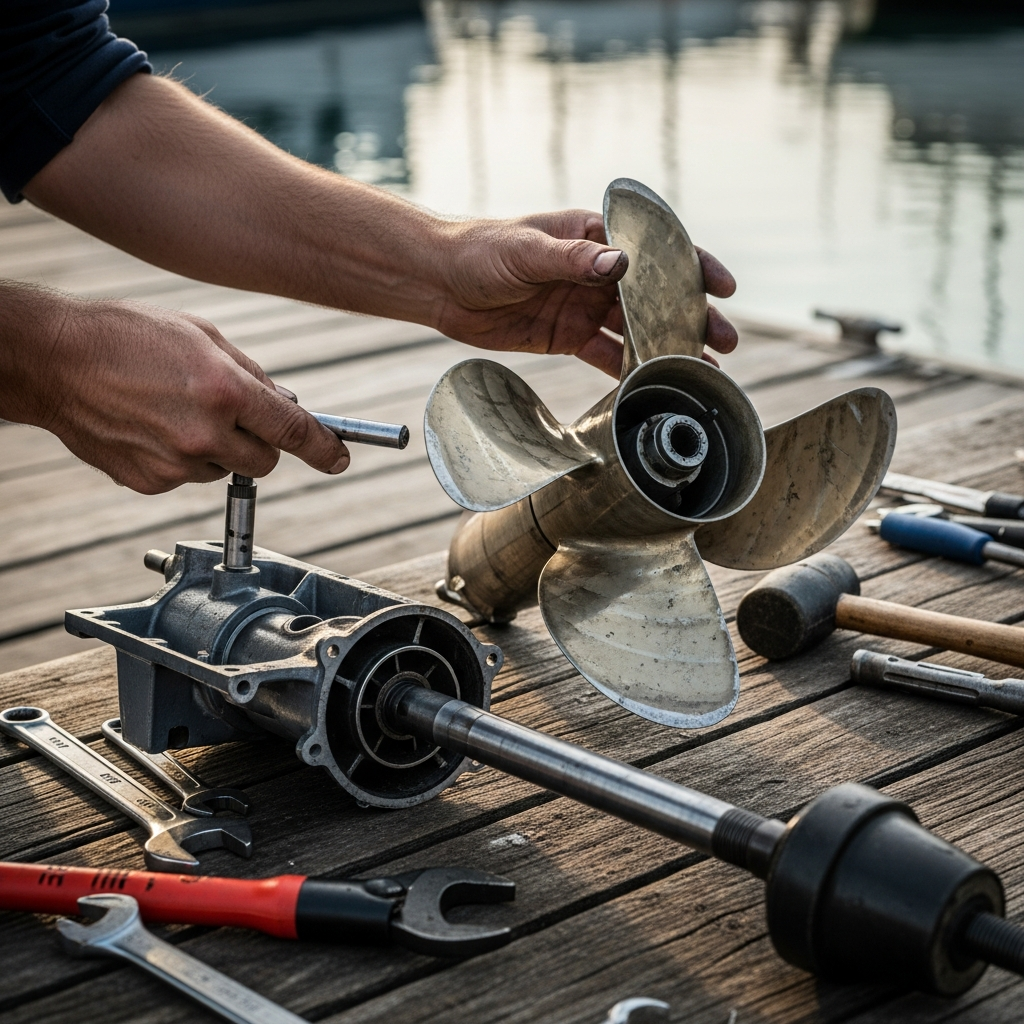
Prop hub separation is the other common prop-related knock. The rubber hub between the prop and the prop shaft absorbs shock. When the hub separates or deteriorates, the prop slips on the shaft and produces a slapping sound with a noticeable loss of thrust. The engine revs freely but the boat does not accelerate — the prop is spinning but not fully driving the shaft.
Both require removal and inspection by a prop shop. Do not continue running with suspected prop damage. The vibration from a bent blade transfers through the prop shaft to the gear case bearings, and running with that vibration for hours can damage the lower unit seals and bearings — turning a $150 prop repair into a $1,500 gear case rebuild.




Stay in the loop
Get the latest nautical soundings updates delivered to your inbox.